(Image source from: Thesun.co.uk)
Israeli military authorities have stated that Iran has launched ballistic missiles containing cluster bombs aimed at Israeli land, which is the first time such weapons have been reported in this ongoing conflict.
Cluster bombs are regarded as one of the most debated types of modern explosives. Their key feature is their ability to spread numerous smaller bombs over a large area. Israeli defense officials mentioned that certain cluster missile warheads from Iran could release as many as 80 smaller explosives in the air, scattering damaging pieces over several kilometers. Military experts caution that the use of these weapons alters the situation in the war. Rather than just one explosion at a specific point, a cluster munition can distribute many smaller explosives over a broad area, increasing the danger for civilians and leaving behind unexploded devices that can remain dangerous long after the fighting is over.
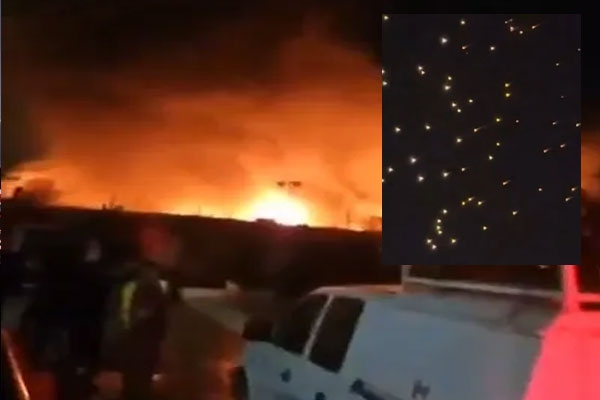
The current discussion revolves not just around the immediate threat to military safety but also how Iran acquired this capability, noted especially in a nation where scientists involved in advanced weaponry projects have often been targeted for assassination. Experts from Israel have hinted that outside help might have contributed, leading to speculation about possible military technology exchanges from Russia or China. Israeli military officials reported that at least one Iranian ballistic missile with cluster bombs hit central Israel during recent assaults. Reports from Israel indicate that the missile's warhead opened up at around four miles, or approximately seven kilometers, above the ground, releasing around 20 smaller explosives over an area of about five miles, or around eight kilometers, in central Israel.
One of the smaller bombs hit a house in the city of Azor, located to the south of Tel Aviv. Although this caused some damage to the building, reports say there were no injuries. Other attacks did result in injuries. An Iranian ballistic missile carrying cluster bombs fell near Tel Aviv, injuring a minimum of 12 individuals. Since February 28, Iranian missile attacks have led to at least 11 deaths in Israel and have injured over 1,000 others to varying degrees, according to NBC News reports.
The Israeli military has issued a warning graphic to inform the public about the risks associated with unexploded small bombs. Brigadier General Effie Defrin, who speaks for the Israeli military, informed journalists that Iran has used weapons intended to maximize harm to civilians. "The terror regime aims to harm non-combatants and even utilized weapons that can spread widely to increase the extent of the destruction," he remarked.
Iran's missile operations have persisted over the week, although the number of launches has varied. On March 3, Iran launched at least six missile attacks aimed at Israel. The same amount of attacks occurred the day before. This shows a notable decrease from February 28, when Israeli authorities noted at least 20 missile attacks in just one day. Even with the reduced frequency, Israeli defense officials state that the deployment of cluster warheads presents a newly complicated challenge. These types of weapons spread numerous explosives over urban regions, making it harder to intercept them and raising the chance of additional dangers on the ground. Officials believe Iran has launched at least five cluster missiles targeting Israel since Saturday, all aimed at crowded civilian areas.
On Tuesday, two such missiles were fired in a barrage towards central Israel. These assaults resulted in damage and injuries in numerous places.
A standard ballistic missile usually carries one large warhead that weighs between 500 and 1,000 kilograms. Cluster warheads operate differently. Instead of exploding in one blast, the missile opens up in the air and releases smaller bombs. Each of these smaller bombs generally holds an explosive weight of up to seven kilograms, roughly equivalent to the explosive power of short-range rockets used by groups like Hamas and Hezbollah. Although each individual explosion is smaller, the total area destroyed can be much larger since the smaller bombs spread out over a wider region. Israeli defense officials indicate that in the latest attack, the missile's warhead broke apart at around seven kilometers in the air, scattering its smaller bombs over an area with an eight-kilometer radius.
Military analysts point out that cluster munitions are especially hazardous when they are intercepted mid-flight. If a missile goes through its full path, its smaller bombs usually detonate when they hit the ground. However, if the missile is intercepted while still in the air, these smaller bombs can fall in unexpected ways, sometimes exploding upon landing and at other times failing to explode. These unexploded bombs can go off later if they are disturbed, creating ongoing dangers for local people and rescue workers. The most serious long-term risk associated with cluster munitions is the unexploded smaller bombs. A large portion of these bombs do not explode upon hitting the ground. These inactive explosives can remain hazardous for years, effectively acting like makeshift landmines.
Israeli defense officials state that Iran first used cluster missiles in the conflict between the two nations in June last year, which lasted for twelve days. During that battle, it is believed that three cluster missiles were fired at Israel, hitting seven different cities. Therefore, the ongoing war marks the second time these weapons have been utilized in this rivalry. Israeli military experts think that Iran has created at least three types of missiles that can carry cluster warheads. These include the Zolfaghar missile for short distances, the Qadr series for longer ranges, and the bigger Khorramshahr ballistic missile. Among these, the Khorramshahr is viewed as the most powerful model. Iran asserts that this missile can reach around 2,000 kilometers and can hold up to 80 cluster bomblets. Iran usually does not publicly talk about making cluster munitions. Still, there are signs that the country produces these types of weapons for use with both ballistic missiles and rockets. Reports from Iranian state media indicate that the locally made Qadr S ballistic missile is equipped with a cluster munition warhead and has a range of approximately 2,000 kilometers.
Details regarding the amount and weight of the submunitions carried by this missile have not been revealed to the public. Reports from Western media have suggested that Iran's Zolfaghar ballistic missile might also be able to deliver cluster munitions. Back in 2015, Iranian officials showcased a version of the Fateh missile that carried 30 submunitions, with each one weighing around 20 pounds. There could be other Iranian missiles that have been modified to carry similar loads. According to analysis mentioned by The New York Times, either a Qiam series missile—which is based on the Soviet-era Scud design—or a larger Khorramshahr missile could have delivered the cluster munitions reportedly used in an attack on Israel on June 19, 2025. Iran also manufactures various types of unguided rockets, such as the 122mm, 240mm, and 333mm systems. It is still uncertain whether these rockets can hold submunition payloads.
Open-source intelligence from Jane's Information Group has identified that Iran possesses several foreign cluster systems, including KMGU dispensers meant to release submunitions, as well as PROSAB-250 and BL755 cluster bombs made in the UK. Iran has never publicly revealed the amount or kinds of cluster munitions it has in its inventory. The use of cluster weapons has sparked significant global controversy. In 2008, over 100 countries agreed to the Convention on Cluster Munitions, an international treaty that prohibits the use, production, transfer, and storage of these weapons. A total of 111 countries and 12 other entities have joined this treaty. Both Israel and Iran did not sign the treaty. The United States also chose not to participate in the convention. The issue gained renewed global attention in 2023, when the U. S. provided cluster munitions to Ukraine to use against Russian forces. Ukraine has reported that Russian troops have also deployed cluster weapons during the ongoing conflict.